
Written by Danica Roberts
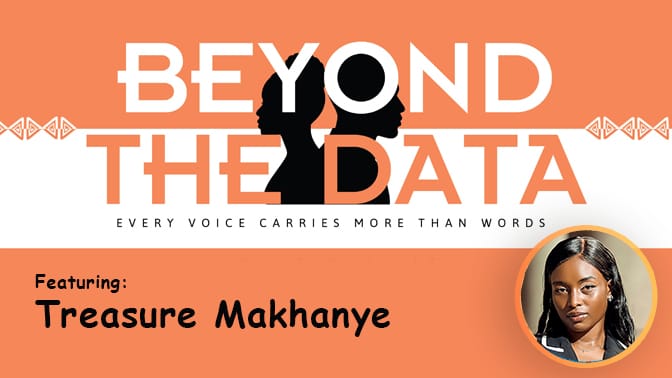
Beyond the Data: The Weight of Being Seen
A Xitsonga Language Manager reflects on recognition, representation, and reconnecting with her mother tongue through Africa Next Voices. Treasure Makhanye shares how ANV helped Xitsonga be seen in technology and media.
A Language Manager’s reflection on the power of recognition.
It is undeniable that, in its truest essence, language is not defined merely by words. Here at Way With Words, we have come to understand that there are moments where language becomes a quiet assertion of existence – an intangible reflection of life beyond its orthography.
One of our Xitsonga Language Managers, Treasure Makhanye, reflects on what it means not solely to work with Xitsonga, but to stand in a space where the language is fully acknowledged, carried and seen.
The Silence Around a Language
Before our African Next Voices (ANV) project, Treasure found that the absence of Xitsonga in many spaces had become the norm, particularly in spaces that shape visibility and value. Media and technology frequently overlooked it and, over time, that absence can begin to feel like erasure. That’s why ANV mattered! She says:
“Xitsonga is one of the languages that you don’t usually encounter in media spaces… Leading a project that would allow the language to be represented and given the same respect and recognition as all the other South African languages was an honour for me.”
There is something profound in the word honour. It evokes a deep sense of responsibility and representation. For Treasure, representing a language like Xitsonga meant not only completing a task, but also carrying something that had not always been carried in these spaces before.
Recognition Begins Within
Before recognition becomes external, it often stirs quietly within. In reconnecting with Xitsonga through ANV, something shifted for Treasure. She reflects:
“The last encounter I had with my mother tongue in its purest state was in 2019 when I was in high school. The project helped me reconnect with that part of myself.”
That reconnection speaks to a deeper truth: when a language is underrepresented, its speakers may begin to feel that distance too. Returning to it, by engaging with it deliberately, professionally and intentionally, becomes an act of reclaiming something that was never truly lost, but not always affirmed.
And Treasure’s journey, however, was not built entirely on certainty, for she explains:
“It was honestly a learning process for me… I had never worked in the language space before.”
There’s a vulnerability in stepping into something that is unfamiliar, especially when what you are carrying holds cultural weight. But Treasure understood that this work could not be done alone. There is power in collective learning and shared knowledge:
“I drew and learned from the experiences of the other language leads who carried me.”
Recognition, here, becomes something communal. It is built through people, through support, and through the willingness to grow together.
The Responsibility of Language
In working closely with Xitsonga through ANV, Treasure was exposed to a different understanding of language and its significance.
“Language is not just about communication, it is a powerful thing, tied to so many emotions and feelings of pride.”
Being involved as a Language Manager gave her the understanding that every word carries context. Within language lives history, geography, memory, and lived experience. Xitsonga itself stretches across regions and borders, shaped by Mpumalanga, Limpopo, Mozambique, and beyond. It is not singular. It is layered.
“I had to teach myself to be open-minded, and to do research before dismissing certain words as ‘invalid’.”
In shifting her mindset towards curiosity and exploration, Treasure came to recognise that language cannot be confined to rigid definitions without losing something essential. What may seem unfamiliar is not necessarily incorrect, but instead reflective of a different lived reality.
To Be Seen Fully
If there is one defining thread throughout Treasure’s experience, it is the idea of being seen, not partially or conditionally, but wholly.
“It made me feel seen as an African… It made me feel like my people were being seen and recognised and given the respect they deserve.”
There is a quiet gravity in her words. Recognition is not merely visibility; it is validation. It is the distinction between existing and truly being acknowledged. And this feeling extends beyond the individual. When asked what she would hope the members of her community would feel if they read about the difference she made in contributing to ANV, Treasure responded with:
“Represented. I hope I did enough and I hope I brought them pride.”
There is a collective dimension to this work, found in a sense that each contribution carries the weight of many voices, histories and identities.
The First Brick
”…I’ve cemented my name in history… I was one of the people who laid the first brick for African language technology.”
There is humility in that image, but also permanence. A first brick may not be the whole structure, yet it makes everything else possible. It signals a beginning where there may once have been none. And yet, beginnings can be fragile. Recognition, once initiated, must continue to be nurtured and sustained.
“ANV has given me hope… I hope it’s a start. I hope Xitsonga is included in any and all developments to come.”
Hope, here, is not passive. It is tied to action, to continuation, and to the belief that this visibility will not fade back into absence.
Reflections
At its core, this story asks a simple yet powerful question: what does it truly mean for a language to be recognised? Perhaps it is this:
“Xitsonga is such a beautiful language… people don’t know it is beautiful and deserves as much respect as theirs do.”
Recognition, then, is not about elevating one language above another. It is about restoring balance. It is about ensuring that beauty is not hidden simply because it has not been widely seen. And in that sense, this work is not only about data, or technology, or even language itself. It is about dignity. When a language is truly recognised, it does more than appear. It affirms. It tells its speakers: you are here, you matter, and your voice belongs.
We are deeply grateful to Treasure Makhanye for lending her time and experience to African Next Voices.
You can connect with Treasure here:
By working together, we are not only building datasets — we are building belonging. This is where speech meets purpose.
More Beyond the Data stories
Explore more recorder reflections from our community.
Beyond the Data: The Quiet Truth About Mastery
7 May 2026
Beyond the Data: Language as Living Identity in a Digital Age
10 April 2026
Beyond the Data: Rooted in Language
1 April 2026
Beyond The Data: Authenticity in Every Word
17 March 2026
Beyond the Data: Every Voice Carries More Than Words
14 February 2026