
Written by Danica Roberts
Beyond the Data: The Quiet Truth About Mastery
A proofreader’s reflection on what mastering a language really looks like
A proofreader’s reflection on what mastering a language really looks like
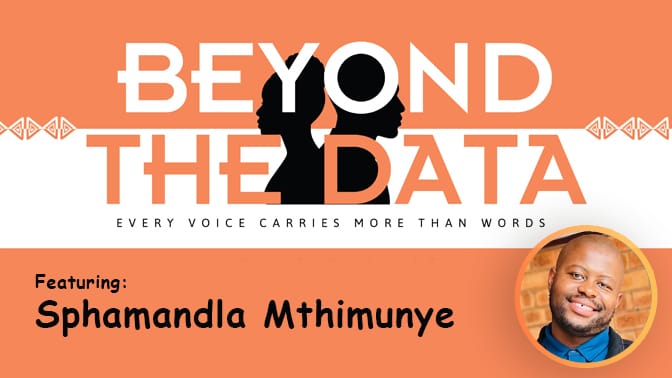
In conversation about language, the term ‘mastery’ may be understood as something definitive, such as a destination where fluency evokes confidence and accuracy feels complete. But the more we at Way With Words are exposed to this field, the more we come to understand that this is not the case. Language is not a conquerable task, but rather something that opens one up to continuous learning. One of our isiNdebele proofreaders, Sphamandla Mthimunye, shares his experience of engaging with language in a way that redefines what mastery truly means.
When Confidence Meets Complexity
Before our African Next Voices (ANV) project, Mthimunye felt secure in his mother tongue, isiNdebele, grounded in years and years of practice and familiarity. As a prospective language practitioner, he believed that the knowledge he had was sufficient.
However, through his daily engagement with isiNdebele through ANV, he began to see how easily comfort can consume depth, and how much more there is beneath the surface of even a familiar language. He explains:
“…the project made me realise that I still had more to learn, especially when it came to grammar and orthography.”
Rather than undermining his confidence, this became a turning point in his perspective. It marked the beginning of a more attentive way of engaging with language, one rooted in discovery, and in listening more closely to what isiNdebele had to say.
Listening Beyond Words
The more Mthimunye listened, the more he came to understand the diversity which exists within isiNdebele. This was often reflected in the way people expressed the same ideas, a manner in which differences would either be revealed through subtlety or in an obvious way.
“It was fascinating to hear people defining [the] same things differently.”
While these differences might be overlooked, the more Mthimunye listened, the more he recognised their significance. Each distinction held traces of something deeper, such as where speakers came from, how they understood the world, and the cultural frameworks which shaped their expression. Mthimunye, therefore, was no longer listening for accuracy and fluency, but for meaning. Beyond words lies intention, context and nuance.
Through this way of listening, he moved from simple observation to a deeper understanding that language does not exist independently of its speakers. Instead, it is shaped by the histories, environments and the everyday experiences. In this sense, the connection between language and culture becomes both visible and essential.
Language as Culture, Culture as Language
As this awareness deepened, so too did an appreciation for the cultural richness embedded within the language itself.
“Cultural knowledge helps a person understand what certain terms [and] expressions mean due to the fact that they are shaped by traditions and everyday experiences.”
Language holds memory, identity and ways of seeing the world. To fully understand a word is to understand the context that gives it life. Variation across speakers is, therefore, a natural expression of this. Mthimunye reflects:
“A language adapts differently to regional cultural influences… preserving the language’s uniqueness, whilst also making it richer.”
With this view, language becomes something living: constantly evolving and adapting, and deeply rooted in its speakers. It is only natural that a growing sense of responsibility begins to emerge.
More Than Participation
For Mthimunye, ANV was more than an experience. It was an opportunity to contribute to something collective and enduring.
“My participating… was an opportunity for me to contribute to the preservation of my identity… if its language dies, so [does] its people.”
With the advancement of technology, projects like ANV play a significant role in representing language, ensuring that languages like isiNdebele are not only preserved, but are easily accessible, usable and visible to present and future speakers.
“I would love to see the future generations, our children, grandchildren and great-grandchildren get to easily access all kinds of information in different websites in isiNdebele.”
This hope reflects a future where language is not left behind, but brought forward in a way that represents its roots authentically.
A Master of Learning
Mthimunye reflects on his experience of ANV as “enriching and enjoyable” and one that he would definitely participate in again and recommend to others. Through reflection, he arrives at a deeper truth of what it means to truly know a language:
“Mastering a language is not about thinking you know everything, but about being willing to keep learning… only the one who understands that language is a lifelong learning process can be called a master.”
Reflections
What lives beyond the data is not only the work completed, but the perspective gained. Language is never truly finished. It grows, it shifts, it deepens over time. To engage with it fully means being open to its evolution. In doing so, we come to understand that mastery is not the destination, but rather a continuous and meaningful journey of discovery.
And at Way With Words, we are privileged to have a front-row seat to that journey.
We are deeply grateful to Sphamandla Mthimunye for lending his time and experience to African Next Voices.
You can connect with Sphamandla here:
By working together, we are not only building datasets - we are building belonging. This is where speech meets purpose.
More Beyond the Data stories
Explore more recorder reflections from our community.